Skip to content

Pay Compression: Practical Steps to Audit Salary Bands and Identify Risks Early

The rapid increase in the National Living Wage (NLW) and Real Living Wage (RLW) in recent years has made pay compression an increasingly urgent issue to address. Pay compression occurs when differences in pay between roles narrow to the point that they no longer reflect differences in seniority, responsibility and expectations. Historically, this mainly occurred when no pay structures were in place, with pay decided on an ad-hoc basis and commonly negotiated by individuals. Pay compression has therefore become an increasingly common challenge, even in well-designed pay structures, as organisations respond to external pay pressures.
Growing pay transparency requirements may make pay compression more visible to employees and candidates. This further underlines the importance of regular audits to ensure pay remains fit for purpose.
How pay compression affects pay structures
Pay compression can make it difficult to attract and retain staff in the affected higher-level roles when additional responsibility may not appear sufficiently rewarded. Many companies have struggled to recruit for supervisory roles that pay only slightly more than the team they manage. This can undermine employee engagement and motivation, particularly where the additional responsibility is not reflected in a meaningful pay differential. It can also weaken incentives for career progression and make succession planning more challenging.
It can occur at any level but is more common in the lower levels of a hierarchy, which have been particularly affected by the government policy to increase NLW to two-thirds of median salary. The chart below shows how the rapid growth seen since 2018 has led to above-average increases in pay for more junior roles, with less growth seen higher up the salary scales.
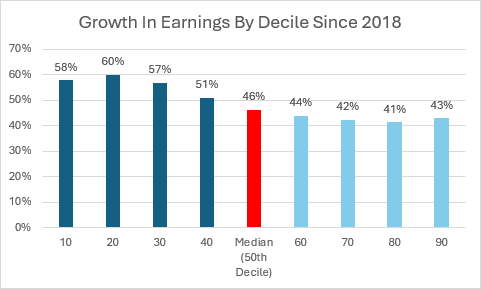
Source: ASHE data
Auditing salary bands can reveal the effects of pay compression
To assess the impact of pay compression, we recommend undertaking regular salary band audits. Best practice would be to do this annually as part of the pay review process. We recommend the following approach:
- Analyse salary distribution across bands
Calculate how each employee’s salary compares to the band median and plot the distribution across each quartile of the salary band.
If the majority of employees are already sitting in the upper quartile, this may be an early warning sign of pay compression. Consider whether this reflects genuine experience and performance or a lack of headroom within the band. This approach can also help identify outliers that may require attention during the annual pay review.
Organisations without formal salary bands can still review pay distribution at different levels, benchmark comparable roles and review salaries in departments or job families to assess compression.
- Evaluate how people progress along a salary band
Review how pay progression operates and whether the mechanism is working as intended. If it results in most employees progressing rapidly to the top of the salary band, it may be contributing to compression rather than supporting meaningful pay differentiation. Some organisations have moved away from pay progression at the lower salary bands, instead favouring spot salaries to maintain gaps between salary levels.
- Review how the salary bands are structured
When designing or updating salary bands, consider how wide these should be to avoid overlap and compression, and whether this is intended and delivering the right outcomes. Band overlap can provide flexibility, but as pay bands have narrowed, it has also increased the risk of compression between seniority levels. Consider whether the width and overlap of bands still support meaningful differentiation between roles.
- Allow for future pay growth
Model different scenarios for likely NLW and RLW increases when reviewing salary bands. This can help identify where salary differentials may narrow further over the next few years and allow organisations to plan ahead.
- Look beyond salary
Consider wider benefits or opportunities available at each salary band level. It may also be possible to clarify the salary progression available to more senior roles as employees progress through the structure. Clear opportunities for salary progression can help distinguish more experienced or specialist roles from entry-level positions. Consider these alongside internal pay relativities and external market benchmarking to ensure the overall reward structure remains competitive and equitable.
Focus on prevention
Pay compression usually occurs gradually as a result of external pay pressures, annual pay reviews and changing market conditions. Regular salary band audits, supported by external market benchmarking and forward modelling, can help organisations identify emerging risks early. Taking a proactive approach allows reward teams to address salary differentials before they begin to affect employee engagement, recruitment and retention.
How we can help
Turning Point helps organisations build effective, sustainable pay structures. We can support you with salary benchmarking, pay structure reviews and audits to identify pay compression risks and ensure your salaries remain fair, competitive and fit for purpose.
Get in touch with our team to arrange an introductory discovery call.
By Caroline Pryce, Reward Consultant
More News

5 Ways to Keep Your Job Architecture Relevant and Effective

Autumn Budget 2026: What It Means for Employers