 Skip to content

New Real Living Wage Rates for 2025/26 Confirmed

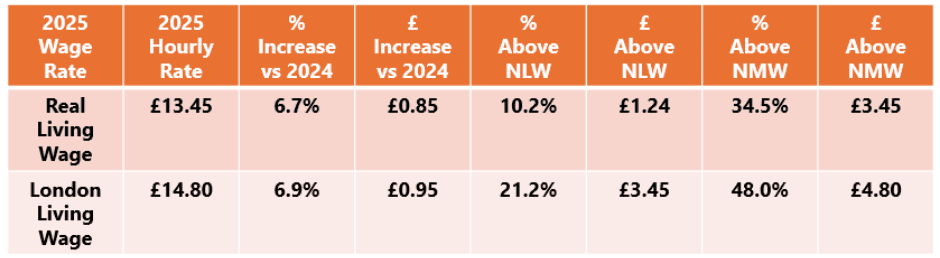
The Living Wage Foundation have announced that the Real Living Wage (RLW) for 2025/26 will increase by 6.7% to £13.45 an hour, with the London Living Wage (LLW) increasing by 6.9% to £14.80 an hour. Employers signed up to the scheme will have until 1st May 2026 to implement these increases.
The Real Living Wage is a voluntary hourly wage rate paid by over 16,000 organisations in the UK. It started as a campaign for a London Living Wage in 2001, expanded to the rest of the UK in 2011, and is credited with driving significant pay increases for employees covered by the scheme. As employers get to grips with the consequences of this year’s increase, here’s what you need to know and how to plan ahead.
New Real Living Wage rates and salary equivalents
When paid as a salary, here is what the new RLW and LLW equate to:

This is how the RLW and LLW compare to the current National Living Wage (NLW) and the National Minimum Wage (NMW). It is important to note, however, that the NLW and NMW will be increased from April 2026, and any comparison for 2026 is therefore short-term.
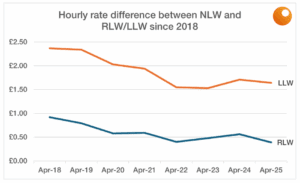
Since 2018, the gap between the RLW/LLW and the NLW has narrowed considerably due to the government’s commitment to reach two-third of median earnings by 2024. The April 2026 rates are not included on this chart as the 2026/27 NLW/NMW rates have not yet been announced by the government.
Who qualifies for the Real Living Wage?
It applies to all staff aged 18 and over employed by organisations that have signed up to the voluntary RLW/LLW – this includes directly employed staff and contractors and is estimated to cover around half a million people. It is a separate scheme to the NLW and NMW, which are both government-mandated minimum rates of pay that vary according to age.
Employers must be accredited by the Living Wage Foundation to use the RLW/LLW logo and be listed publicly.
When will the 2025/26 Real Living Wage increases take effect?
The Living Wage Foundation recommend that rates of pay are increased as soon as possible, and by 1st May 2026 at the latest. In practice, most employers align increases to their usual pay cycles, meaning most increases will occur in January or April 2026.
How is the Real Living Wage calculated?
The RLW methodology calculates the hourly wage rate that workers need to be paid so that they end up with a net income which is enough to buy a basket of goods and services that constitute the defined Minimum Income Standard.
The calculation takes account of the fact that costs vary significantly across family types and the published RLW/LLW rates weigh up the needs of each family type alongside the composition of the population.
The RLW and LLW are calculated separately using the same methodology. The key differences include the higher cost of living in London, and also the differences in composition of the working-age population.
A key element of the calculation is the use of a ‘shock absorber’ – defined as CPI plus or minus 3% – which helps to moderate volatility in annual rate changes. This mechanism has been applied again this year, as it has consistently over recent years. The Living Wage Foundation has confirmed that without it, the rates would have been significantly higher both this year and in previous years.
The core method used to calculate the RLW/LLW has been consistent since 2016 but has been tweaked over the years to account for policy changes and changes to the Minimum Income Standard basket of goods.
What has driven the 2025/26 Real Living Wage increase?
For 2025-26, the key drivers behind the increase are as follows:
- Stubbornly high inflation – data to inform the RLW/LLW was collected in April 2025 when CPI inflation was at 3.5%.
- An increase in the price of the basket of goods and services that constitute the Minimum Income Standard.
- Changes to the make-up of this basket of goods and services in 2024 continuing to make an impact.
- Continued effects of a phased change to the methodology of calculating typical working hours that started in 2023.
- The shock absorber essentially capped this year’s increase. With CPI at 3.8% in July, the increase could not exceed this by more than 3% (it was slightly higher for the LLW due to rounding).
What do we know about the 2025/26 NLW/NMW?
This is due to be announced as part of the Autumn Statement on the 26th November 2025, and will be effective from April 2026. The projected range is between £12.55 and £12.86 with a central estimate of £12.71. The method used to calculate the NLW/NMW is not the same as for the RLW/LLW so we cannot infer the increase based on this week’s announcement. Based on the current projection of an increase between 2.8% and 5.3%, it is likely to be a lower increase than the RLW/LLW but it may be wise to expect an increase at the higher end of this projection.
How can employers prepare for the 2025/26 Real Living Wage increase?
There are a number of steps employers can take when introducing or maintaining paying the RLW/LLW to manage financial impact and ensure long-term sustainability.
- Model likely increases for the next 3-5 years and decide if this would be sustainable for your business. Some employers have withdrawn from the scheme due to increasing costs, which can carry reputational risk.
- Evaluate pay compression risks between employees paid the RLW/LLW and the levels above them.
- Consider reviewing or implementing career pathways to account for potential narrowing of pay between entry-level employees and more senior employees.
- Audit salary sacrifice benefit arrangements to ensure that you are still paying the new RLW/LLW following these deductions.
How we can help
Equipped with comprehensive, robust data and proven methodologies, Turning Point is ideally suited to help you navigate these changes. Our team can help you manage the impact on your pay structure and ensure you have a sustainable strategy and framework in place that is right for your business and your people.
If you have any questions or need help with any aspect of your pay and reward strategy, please contact our team of reward specialists.
More News

5 Ways to Keep Your Job Architecture Relevant and Effective

Autumn Budget 2026: What It Means for Employers
