Skip to content

The Real Living Wage, the National Living Wage and the National Minimum Wage: What’s the Difference?

We understand that keeping up with ever-changing legislation can be a real challenge. Indeed, conversations with our clients since the new wage rates were announced in October have revealed an element of confusion between the Real Living Wage (RLW) and the National Living Wage (NLW), with some asking what the Real Living Wage is, and whether it’s statutory.
Here’s everything you need to know.
The Real Living Wage
Designed and set by the charity the Living Wage Foundation, the Real Living Wage is not legally mandated but is a voluntary benchmark calculated by estimating the rate that is needed to meet the costs of living, based on a ‘basket of household goods and services’.
The wage rate applies to all employees aged 18 and over and includes a separate London weighting, to reflect the increased cost of living in the capital.
The new 2024-25 Real Living Wage rates, announced in October, are £13.85 in London and £12.60 elsewhere, benefiting nearly half a million UK workers employed by over 15,000 businesses that voluntarily adopt this rate.
Reasons why employers choose to pay a Real Living Wage include:
- Increased motivation and retention rates for employees;
- Boosting business reputation;
- Differentiation from competitors;
- Improved relationships between management and employees.
However, it should not be confused with the statutory National Living Wage explained below.
The National Living Wage
The National Living Wage is a statutory requirement and is the National Minimum Wage for employees aged 21 and over.
Unlike the Real Living Wage, there is no additional London weighting.
Reviewed annually, it currently stands at £11.44 per hour and will rise by 6.7% from 1 April 2025 to £12.21.
The National Minimum Wage
The National Minimum Wage is also a statutory requirement and applies to younger workers under the age of 21 and of at least school leaving age.
The hourly rate for the minimum wage depends on your age and whether you’re an apprentice.
The rates change on 1 April every year.
Current statutory minimum wage requirements are summarised in the table below (note that apprentices are entitled to the apprentice rate if they are aged under 19, or aged 19 and over but in the first year of their apprenticeship).
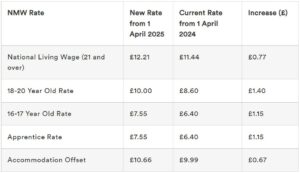
The National Minimum Wage (NMW) and National Living Wage (NLW) are legally enforced, and employers are required to pay these rates to all qualifying workers. Non-compliance can result in significant fines and back-pay orders from HMRC, as seen in recent high-profile cases where major companies were penalised.
The Low Pay Commission (LPC), an independent body comprising employers, trade union representatives, and experts, is tasked with advising the government on wage thresholds and balancing wage increases with the risk of job losses or reduced hours for low-paid workers.
You should regularly review pay levels to make sure your employees are being paid correctly.
If you discover any discrepancies, make sure these are resolved quickly before they escalate into larger issues.
Turning Point Can Help
With over 20 years of experience, pay structure design is at the heart of the reward initiatives we undertake for our clients across multiple sectors.
Turning Point is ideally suited to help you prepare for the upcoming changes to the National Minimum Wage (NMW) and National Living Wage (NLW) from April 2025. Our team can help you manage the impact on your pay structure and ensure you have a sustainable strategy and framework in place that is right for your business and your people.
Want to find out more? Contact our team of reward specialists on 0203 475 2270 or email us at info@turningpointhr.com.
More News

5 Ways to Keep Your Job Architecture Relevant and Effective

Autumn Budget 2026: What It Means for Employers