 Skip to content

New National Living Wage for 2026/27 Confirmed

The government has announced that the National Living Wage (NLW) will increase by 4.1% to £12.71 an hour from April 2026. The National Minimum Wage (NMW) for 18- to 20-year-olds will also increase by 8.5% to £10.85 an hour.
The NLW is the minimum wage rate for employees aged 21 and over, with two separate NMW rates applying to 18- to 20-year-olds and 16- to 17-year-olds. The government are moving towards one rate for workers aged 18 and over, hence the higher increase for the NMW this year. The NLW/NMW is separate to the Real Living Wage scheme, which is voluntary.
Key figures
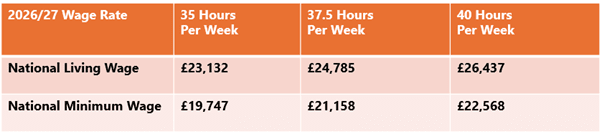
When paid as a salary, here is what the new NLW and NMW equate to:
This is how the NLW and NMW compare to the recently announced Real Living Wage (RLW):
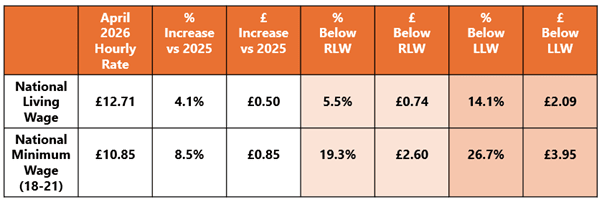
Since 2022, the differential between the NLW and RLW had been narrowing, signalling potential alignment. In 2025, however, the gap reverses course – jumping from 3.2% to 5.5%.
These increases continue the trend for significant NLW/NMW growth since the government declared their intention for NLW to reach two-thirds of median earnings. In 2018 (the year prior to this announcement), the NLW was £7.83 an hour and applied to workers aged 25 years and over. Since then, we have seen an increase of 62%, with an 84% increase to the NMW.
This year, however, represents the lowest NLW increase since April 2021 – a year heavily affected by the ongoing impacts of the pandemic on employment and wage growth. It is also the first time since 2021 that the announced rate aligns with the Low Pay Commission’s mid-year central estimate.
When is the increase happening?
The new rates will come into effect on 1 April 2026. In practice, many employers include these increases within their usual pay cycles, meaning some will occur before this if they fall before April.
How is it calculated?
The Low Pay Commission (LPC) makes annual recommendations on NLW/NMW increases, which the government reviews and implements if in agreement. The government set the remit for this review, which this year included ensuring the NLW remains at two-thirds of UK median earnings, while also taking into account cost-of-living and inflation forecasts.
There is not a set formula for determining the rates. The Low Pay Commission balance a number of factors to arrive at their final recommendation. Tracking earnings trends and inflation forecasts can give an indication of the potential size of the increase. These are factored into the central projections published by the LPC during the year, although prior to this year these projections have often been slightly under the eventual rate.
How can employers plan ahead?
It can be challenging for employers to plan their pay strategies against a backdrop of unpredictable NLW/NMW increases. However, there are a number of steps organisations can take to position themselves as well as possible.
- Anchor pay modelling in the Low Pay Commission’s NLW/NMW estimates, updated during the year to reflect the government’s policy trajectory and economic conditions.
- Incorporate and stress‑test LPC figures as directional guidance, using both the central estimate and range to build resilience into pay frameworks.
- Evaluate pay compression risks between employees paid the NLW/NMW and the levels above them.
- Consider reviewing or implementing career pathways to account for potential narrowing of pay between entry-level and more senior employees.
- Audit salary sacrifice benefit arrangements to ensure that you are still paying the new NLW/NMW following these deductions.
How we can help
Equipped with comprehensive, robust data and proven methodologies, Turning Point is ideally suited to help you navigate these changes. Our team can help you manage the impact on your pay structure and ensure you have a sustainable strategy and framework in place that is right for your business and your people.
If you have any questions or need help with any aspect of your pay and reward strategy, please contact our team of reward specialists.
More News

5 Ways to Keep Your Job Architecture Relevant and Effective

Autumn Budget 2026: What It Means for Employers
